Northern Lights Escapes covers where, when and how to read the odds. Our travel team at The JLT Group plans and books your trip.
Will the northern lights show tonight?
Nobody can say for certain. You can read the signs, though. Three things have to line up. The sky must be clear, it must be dark, and there must be enough activity. The Kp number measures that last one.
NOAA, the US space-weather agency, says the sky must be clear of cloud and dark. Our page on the cloud forecast covers the first part. This page covers the second and third.
People ask this a lot. We analysed 6,796 published trip questions and reports (October 2024 to October 2026, date ranges differ by group). Of these, 929 (14%) were about odds and forecasts. Of the 2,020 questions, 250 (12%) were. More than half of those 929 posts, 517, came from one UK-based source, so the count leans towards people watching from home.
929 of 6,796
What does the Kp number mean?
It is a storm gauge. NOAA's planetary K-index is a whole number from 0 to 9. A 1 is calm, and 5 or more counts as a geomagnetic storm.
NOAA builds it from 13 observatories. Each value comes from the biggest swing in the magnetic field during a three-hour interval. So a Kp reading is the peak of its three-hour block. It is not three hours of show. The real-time value is labelled as estimated.
What Kp do you need?
It depends on where you stand. NOAA names storm levels from Kp:
- Kp 5 is G1, Kp 6 is G2 and Kp 7 is G3.
- Kp 8 is G4, and Kp 9 is G5.
NOAA counts how often each happens across an 11-year solar cycle. G1 takes about 900 days, G2 about 360, G3 about 130, G4 about 60 and G5 about 4. Higher storms are rarer, and they push the aurora further from the poles.
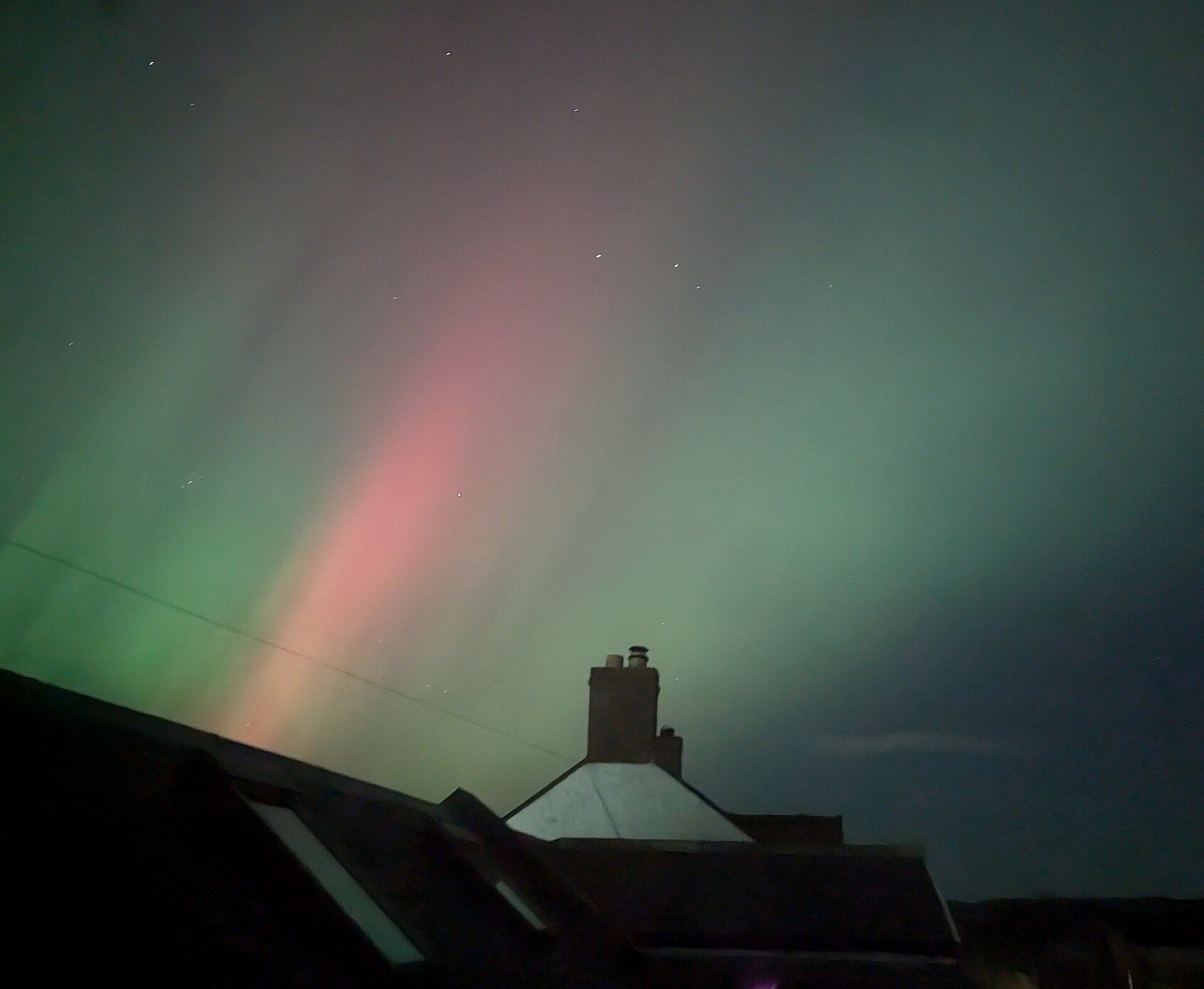
For a UK reader, the Met Office says Kp 6 to 7 can make the aurora faintly visible from the UK. Kp 8 to 9 and above is needed to bring it directly overhead. We cover that on seeing the lights from the UK.
Kp 6 to 7
Inside the oval, you need less. Our own odds count a night as active at Kp 2 or more, because Abisko and Tromsø sit under the oval. That is our rule, and a low bar. Raise it to Kp 3 and the picture changes. At Abisko, about 7.8 in 10 four-night stays in February had a good night over the last 7 winters. At Kp 3 or more, that falls to about 5.2 in 10. At Tromsø, over 10 winters, it falls from about 7.2 to 4.4 in 10. This is a record of past winters, not a forecast.
about 7.8 to 5.2 in 10
What do NOAA's watches, warnings and alerts mean?
NOAA publishes three kinds of message about geomagnetic storms. Its K-index page defines them by Kp:
- Watches are issued when the highest predicted Kp for a day is 5 or more, and are reported as a G level.
- Warnings are issued when a Kp of 4, 5, 6, or 7 or greater is expected.
- Alerts are issued when the Kp reaches 4, 5, 6, 7, 8 or 9.
In plain English:
- Watch. Think days ahead. A typical headline reads "Geomagnetic Storm Category G1 Predicted", with a level for each of the next three days.
- Warning. Think the next few hours. A typical headline reads "Geomagnetic K-index of 4 expected", with Valid From and Valid To times.
- Alert. Think it has already happened. A typical headline reads "Geomagnetic K-index of 4", with the time the threshold was reached.
NOAA times are in UTC. In winter that matches UK time. In British Summer Time, add an hour.
An alert tells you the Kp has arrived, not that the sky is clear where you are. Check the cloud before you go out.
How far ahead can anyone tell?
Days ahead for storm levels, and minutes ahead for the detail. NOAA's 30-minute aurora forecast looks 30 to 90 minutes ahead. It uses the solar wind measured about 1.6 million km upstream of Earth. It draws a green oval on a map, and the oval turns red when the aurora is forecast to be more intense.
30 to 90 minutes
NOAA says the aurora does not need to be overhead. It can be seen from up to about 1,000 km away when it is bright and conditions are right. When the solar wind data is missing, the model falls back on the current Kp and gives no lead time.
The Aurora Zone, a tour operator, says it is almost impossible to predict the Northern Lights more than a few hours in advance. Its hunting formula page says weather changes sharply over short distances, and local guides know where clearer sky is building. Those are its own claims.
How good are the odds on a single night?
Lower than most people hope. Over the last 7 winters at Abisko, about 4 in 10 single nights in January had a clear, dark night with the aurora active. February was 3.8 in 10. At Tromsø, over 10 winters, December was 3.8 in 10. These are our past-winter records, not a forecast for any night.
about 4 in 10
That is why more evenings help. Our guide on how many nights explains it, and the full tables are on our Northern Lights Odds press page.
Nobody can promise the lights. A forecast tells you when to go outside. It does not tell you what you will see.
Sources, all read on 21 October 2026 (the alerts feed on the same day): NOAA, aurora · NOAA, planetary K-index · NOAA, scales explanation · NOAA, alerts, watches and warnings · NOAA, aurora 30-minute forecast · Met Office, auroras · The Aurora Zone, frequently asked questions, read 21 October 2026 · The Aurora Zone, hunting formula, read 15 October 2026. Our odds are past winters of weather and aurora records (Tromsø 2016-17 to 2025-26, Abisko 2019-20 to 2025-26). Traveller counts come from published trip questions and reports we analysed (October 2024 to October 2026, counts only). Contains public sector information licensed under the Open Government Licence v3.0. NOAA and the Met Office do not endorse this guide.